More than four in five businesses now use AI in their hiring process. They do it to save time, cut costs, and manage growing application volumes. But the evidence is mounting that many are also screening out the exact people they need.
This investigation sets out what the data shows, what it costs businesses when it goes wrong, and why the human recruiter remains the most important variable in the process.
Executive Summary
AI has become a standard fixture of UK recruitment. Over 90% of large businesses now use it somewhere in their hiring process, and the tools are getting more sophisticated every year. The promise is compelling: faster shortlists, lower costs, less admin, more consistency.
But there is a problem that most businesses have not yet fully reckoned with. The same systems designed to save time are systematically filtering out strong candidates. Not occasionally. Not as a minor side effect. Routinely, at scale, in ways that directly damage the quality of the people businesses end up hiring.
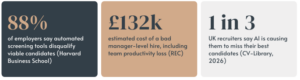
The data on this is not ambiguous. A Harvard Business School study found that 88% of employers believe their automated screening tools are disqualifying viable candidates. CV-Library’s 2026 survey of nearly 500 UK recruiters found that 1 in 3 now say AI is causing them to miss their best people. The ICO audited AI recruitment tools in 2024 and made nearly 300 recommendations for improvement, accepting that the tools pose real risks to fairness, transparency, and data protection.
Meanwhile, the cost of a wrong hire has risen sharply. Under new employment legislation, the REC estimates that replacing a manager on a £42,000 salary who does not work out costs a business £132,000 in lost salary, wasted training, and team productivity damage. The Employment Rights Act 2025 has added further exposure to that figure. Getting recruitment wrong is more expensive than it has ever been.
Copperfield was founded by Laura Dale and Paul Thompson with a straightforward belief: the right hire is a conversation, not a keyword match. We work with businesses who want to know that the person they are interviewing has been properly assessed, properly understood, and properly matched to their requirement, not just algorithmically shortlisted.
This paper explains the evidence behind the problem, puts numbers on what it costs, and makes the case for why human judgement remains irreplaceable in a process that AI has made faster but not better.
1. The AI Screening Story So Far
The adoption of AI in recruitment has been swift and largely unquestioned. When application volumes grew faster than teams could manage them, automation was the obvious answer. Applicant tracking systems had existed for years, but AI added a new dimension: tools that could not just store applications but score, rank, and filter them without human review.
The market followed. Ernst and Young found that 90% of large UK private sector businesses have now adopted AI into their recruitment process. Seventy per cent of enterprise-size businesses use automated CV screening software. The Institute of Student Employers reported that AI use in recruitment tripled in a single year between 2022 and 2023, and the pace has not slowed.
The headline metrics look good. AI can reduce time-to-hire by up to 71% and cut the administrative cost of screening by 80% or more. A recruiter who previously spent 23 hours per hire on initial sifting can now review a pre-filtered shortlist in a fraction of the time. On a spreadsheet, the efficiency case is real.

But the question that got lost in the efficiency conversation is the one that matters most: is the shortlist actually better? Faster and cheaper only creates value if the output is right. And the evidence from employers, candidates, and regulators alike suggests that, more often than not, it is not.
The Keyword Problem
The most widely used form of AI screening works like this: a job description is fed into a system, and CVs are ranked by how closely they match the language in that description. The logic seems reasonable. In practice, it produces a systematic blind spot that experienced recruiters recognise immediately.
A candidate who spent five years managing complex projects, building client relationships, and leading teams may not have used the precise phrase that appears in the job description. If the JD says ‘change management’ and the candidate’s CV says ‘led the transformation of the finance function across three sites’, an algorithm may score them low or reject them entirely. The match they could provide goes unrecognised because the vocabulary is slightly different.
The Stiles Associates research describes this directly: candidates are screened out not because they cannot do the job, but because the language on their CV does not precisely mirror the language on the job description. The same problem applies to qualifications, job titles, and career histories. Rigid parameters punish candidates who describe real experience in plain English and reward those who have optimised their documents for algorithmic consumption.

What AI Cannot Do
Beyond keywords, there are qualities that determine whether a hire succeeds that AI screening tools consistently struggle to evaluate. CV-Library’s 2026 research asked recruiters directly: 72% said AI struggles to identify cultural fit, and 55% said it performs poorly at assessing soft skills.
In most professional roles, these are not peripheral concerns. They are the primary indicators of whether someone will perform, integrate, and stay. A candidate who is technically qualified but does not match the culture of the team is a disruption and eventually a departure. A candidate who is slightly less experienced but brings the right attitude and a clear understanding of what the role needs is often the better appointment by a significant margin.
AI operates in two dimensions. It reads text. It cannot hear how someone describes their experience. It cannot notice the candidate who undersells themselves in writing but is thoughtful and impressive in conversation. It cannot distinguish between the candidate who lists ‘excellent communication skills’ and the candidate who actually has them. These distinctions are what experienced recruiters make every time they pick up the phone.

2. What a Wrong Hire Actually Costs
The efficiency savings from AI screening are real and well-documented. What tends to be far less visible to the businesses using these tools is the cost of the candidates who did not make it through, and more specifically, the cost of the wrong candidates who did.
A bad hire is not just an inconvenience. It is one of the most expensive things that can happen in a business, and in 2026, it is more expensive than it has ever been.
The Numbers
The REC, drawing on UK salary and productivity data, estimates that a bad hire at manager level on a £42,000 salary costs a business £132,000 when the full picture is included: wasted salary, employer contributions, onboarding costs, the lost productivity of the team around them, and the second hiring process that inevitably follows. The Brandon Hall Group found that 95% of UK businesses admit to at least one bad hiring decision every year. Nearly a third have made a bad hire specifically because of pressure to fill a position quickly, which is precisely the condition that makes algorithmic screening most appealing and most risky.
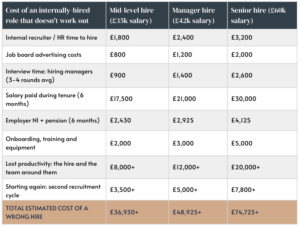
The table below sets out what an internally-hired role actually costs a business when it does not work out within the first year. These figures assume no agency was used: the cost is internal HR and recruiter time, job board advertising, hiring manager interview rounds, salary and employer contributions during the hire’s tenure, onboarding and training, the productivity drag on the team around them, and starting again.
The Hidden Costs
The tables above capture the direct and measurable costs. The harder ones to put on a spreadsheet are often more damaging.
A bad hire reduces the productivity of everyone around them. The REC’s data suggests a struggling employee can cut team productivity by up to 72% as colleagues absorb the training, the mistakes, and the gap between what the role requires and what the hire is delivering. The best people on your team, who joined to work with other high performers, notice this quickly and their patience is not unlimited.
There is also the second recruitment cycle, which almost always happens under worse conditions than the first: more urgency, more pressure, less appetite for proper process. Businesses that shortcut the first hire and pay the cost often shortcut the second one too.
Note:
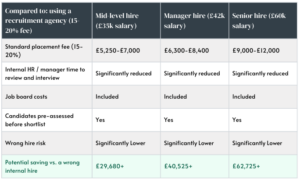
Potential saving is calculated as the total cost of a wrong internal hire minus a recruitment fee at the midpoint of the 15-20% range. It does not account for the additional value of time returned to hiring managers who receive a pre-assessed shortlist rather than sifting unscreened volume applications. That saving is real but will vary by business and role.
Compared to a recruitment fee
The tables above capture the direct and measurable costs. The harder ones to put on a spreadsheet are often more damaging.
A bad hire reduces the productivity of everyone around them. The REC’s data suggests a struggling employee can cut team productivity by up to 72% as colleagues absorb the training, the mistakes, and the gap between what the role requires and what the hire is delivering. The best people on your team, who joined to work with other high performers, notice this quickly and their patience is not unlimited.
There is also the second recruitment cycle, which almost always happens under worse conditions than the first: more urgency, more pressure, less appetite for proper process. Businesses that shortcut the first hire and pay the cost often shortcut the second one too.

The AI Efficiency Trap
The appeal of AI screening is that it saves money upfront. And it does. Reducing the time spent on initial CV sifting is a genuine cost reduction that shows up quickly and visibly in the budget. The cost of the wrong shortlist shows up later, more slowly, and spread across salary, productivity, team morale, and a second recruitment cycle. It rarely gets attributed to the screening decision that caused it.
This is the trap. A business saves time and avoids a fee, runs a faster process, and then spends £36,000 to £74,000 or more replacing the person who got through the filter but should not have. The maths do not work, but the causality is hard to trace, which is precisely why the pattern repeats.
The businesses that hire well consistently are not the ones that move fastest at the top of the funnel. They are the ones that invest in accuracy: knowing who they are actually interviewing before the interview takes place, and having someone in their corner who can tell them the truth about a candidate before an offer is made.

3. The Evidence Against the Shortlist
The data that should concern any business using AI screening is not just that algorithms make mistakes. It is that they make mistakes in a very specific direction: they systematically filter out people who would perform well and systematically admit people who present well. This distinction matters enormously.
What Employers Already Know
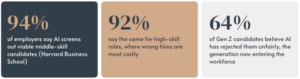
The Harvard Business School statistic deserves more attention than it typically receives. Eighty-eight per cent of employers believe their automated screening tools are disqualifying viable candidates. This is not a minority view or an edge case. It is the assessment of the people running the systems that the majority of hires now flow through.
For middle-skill roles, the figure rises to 94%. For high-skill roles, 92%. The jobs most likely to be screened poorly by AI are the ones where a wrong hire is most damaging and most expensive. And yet the tools designed to make these decisions are ones that the people using them largely do not trust to get it right.
What The Research Found In Practice
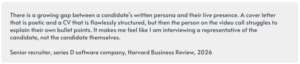
The Harvard Business Review published a study in June 2026 drawing on 120 interviews with talent acquisition leaders and analysis of over 6,000 recorded screening sessions. One finding stands out. In adaptive, reasoning-based interviews where candidates were assessed by humans rather than algorithms, candidates with unremarkable CVs regularly outperformed their more credentialed peers.
Their documents were sparse, or structured differently from what the algorithm expected. In automated screening, they did not make it through. But when a human assessed them on the basis of how they actually thought and communicated, roughly one in four followed this pattern: screened out by AI, hired by humans, and rated as top performers by their managers six months later.
These are not marginal cases. They are not flukes. They represent a structural failure of keyword-based screening to distinguish between presenting well on paper and actually being good at the job. The two things are increasingly unrelated.
What The ICO Found
The Information Commissioner’s Office completed an audit of AI recruitment tools in November 2024 and the findings made uncomfortable reading. Auditors found instances where tools were filtering candidates based on inferred gender and ethnicity, in some cases estimating these characteristics from candidates’ names alone. They found AI systems making consequential rejection decisions without any meaningful human review. Almost 300 recommendations were made across the organisations audited. Every single one was accepted, which speaks to the extent of the problems identified. The ICO was clear: under UK GDPR, automated rejection without human oversight is a legal risk, not just a reputational one.
For businesses using AI to screen candidates, this is not a distant compliance concern. It is a current exposure that most have not properly assessed.


4. The Candidates You Are Not Seeing
The people most consistently filtered out by AI screening are often the people who would make the best hires. This is not a paradox. It is a predictable consequence of what keyword-based screening actually measures.
Who Gets Missed
Career changers who bring transferable skills and a breadth of perspective that sector-specific candidates cannot offer. People with non-linear career paths who have built resilience and adaptability in ways that do not translate neatly onto a chronological CV. Candidates who have done the work under a different job title or in a different industry and describe it in plain English rather than industry jargon. People who are honest and clear about their experience rather than strategic about how they present it.
These candidates are also, consistently, the ones who stand out when someone actually speaks to them. Their stories are substantive. Their reasons for wanting the role are clear and specific. They know what they are looking for and why this particular opportunity interests them. They tend to stay when they join somewhere because they were thoughtful about the decision.
AI does not see any of this. It sees the absence of the right keywords.
The CV Arms Race
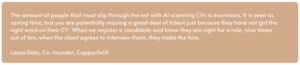
There is a compounding problem. As candidates have become aware that their CVs are being filtered algorithmically, more are using AI to write them. A 2025 study from the University of Maryland, Ohio State University, and the National University of Singapore found that AI screening tools exhibit a form of self preference bias: they favour CVs that resemble the outputs of their own AI systems. Candidates whose CVs were written with similar AI tools were between 23% and 60% more likely to be shortlisted than equally qualified candidates who wrote their own.
The process has turned into a game, and the people gaming it best are not necessarily the strongest candidates. The people least likely to game it are often the most straightforward and most capable. The honest CV is increasingly the one that gets rejected.
The Diversity Consequence
AI tools trained on historical hiring data reproduce historical patterns. If a business’s best hires over the past decade came from a particular type of background, educational institution, or career trajectory, the algorithm will favour candidates who fit that pattern and filter out those who do not, regardless of their actual capability.
The ICO audit found cases where tools were filtering on protected characteristics without employers being aware. The Clevry research found that 35% of AI tools have been shown to introduce or reinforce hiring bias. The businesses with the loudest stated commitments to diversity may be running hiring processes that systematically undermine those commitments without anyone noticing.
This is not a secondary concern. McKinsey’s research consistently finds that diverse teams outperform homogeneous ones. The cumulative cost of building teams that all look the same is not just an ethical one.

5. What Good Recruitment Actually Looks Like
None of this is an argument for removing technology from recruitment entirely. AI handles administrative tasks well and will become more capable. The argument is about where human judgement is irreplaceable and what happens when it is removed too early in the process.
What AI does Well
Writing and refining job descriptions. Scheduling and coordinating interviews. Parsing CVs to extract structured data. Managing candidate communications at volume. Flagging duplicate applications. These are genuine efficiency gains and not trivial ones. A recruiter who spends less time on administration is a recruiter who has more time for the conversations that produce good outcomes.
The Clevry research found that HR professionals are most confident in AI when it is positioned as a decision support tool rather than a decision-maker. That framing is right. AI as an administrative engine, with humans making the substantive judgements, is a model that works. AI as the gatekeeper deciding who deserves to be seen by a human is where the problems compound.

What Humans Do That AI Cannot
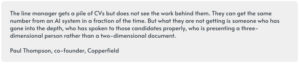
A CV is a document. It records job titles, employer names, and a list of responsibilities. It communicates very little about how someone actually operates, how they handle pressure, how they build relationships, or whether they will be right for this specific role at this specific company.
The work of good recruitment happens in the conversation. Listening to how someone describes their experience. Pressing on the details that do not quite add up. Recognising the candidate who has undersold themselves in writing but is exceptional in person. Understanding the difference between the candidate who performed well in a very different environment and the one who will thrive in this one. This is not instinct or luck. It is skill, built through experience, that produces better outcomes than any algorithm currently running.
When Copperfield puts a candidate forward, we are not sending a document. We are making a recommendation based on a proper conversation with the candidate and a proper understanding of the client’s requirement. We can explain, specifically, why this person is right for this role. That explanation draws on knowledge that no CV contains and no ATS can produce.
6. The Copperfield Approach
Copperfield was founded by Laura Dale and Paul Thompson on the conviction that the quality of the recommendation is the only thing that makes a recruitment consultancy worth using. Our value to clients is not that we can produce shortlists quickly. It is that the people on our shortlists have been properly assessed, genuinely understood, and matched to the role on the basis of knowledge that goes far beyond what their CV communicates.
How We Work
appears on their CV. We understand why they are looking to move, what has driven their decisions to date, what kind of environment they thrive in, and what would hold them back. We know who presents impressively in conversation but has gaps that would matter in this role, and we know who undersells themselves in writing but whose track record and approach is exactly what a client needs.
We do not put candidates forward because they match keywords. We put them forward because, having spent time with them and having properly understood the client’s requirement, we believe they will succeed in the role and stay.
That matters more than ever when the cost of a wrong appointment has risen to the levels the data now shows. Our fee represents a fraction of what a bad hire costs. The value of getting it right compounds in reduced turnover, stronger team performance, and a hiring process that does not need to repeat itself six months later.
What Clients Tell Us
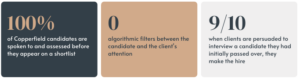
The feedback we hear most consistently from clients is that the candidates we introduce are stronger in interview and in role than those coming through automated channels. That is not a coincidence. It is the result of taking the time that AI, by design, does not take.
We also act as advocates. When a client’s first instinct is to pass on someone based on a quick read of their CV, we can make the case for why they should be interviewed. We can do that because we have spoken to that person and we know something about them that the document does not convey. The data on what happens when clients take that conversation is consistently clear: the hit rate is very high.
Good recruitment is a conversation between people who understand both sides of the hire. That is what we offer. And in a market where AI has made the process faster without making it better, it is the thing that makes the most difference.
Conclusion
AI has a legitimate place in recruitment. It saves time on administration, manages volume, and handles the mechanics of a large hiring process well. Used in that role, it is useful.
Used as a gatekeeper, deciding which candidates deserve to be seen by a human being, it is producing shortlists that the majority of employers already know are not good enough. It is filtering out strong candidates, rewarding CV optimisation over actual capability, creating legal exposure under UK GDPR, and setting the scene for wrong hires that cost businesses far more than the screening ever saved them. The Employment Rights Act 2025 has raised the stakes. A bad hire is not just expensive in management time and lost productivity. It now carries greater redundancy exposure, higher NI and pension costs, and a longer and more complex exit process. The argument for getting recruitment right has never been stronger, and the argument for shortcutting it has never been weaker.
Copperfield exists to do the thing that algorithms cannot: properly understand the people we represent and make recommendations that reflect that understanding. For clients who want to know that their shortlist is genuinely strong rather than algorithmically tidy, that is what we offer.

If you would like to talk about how we work, or discuss a specific requirement, we would be glad to hear from you.
Laura Dale and Paul Thompson
Co-founders, Copperfield
copperfield.co.uk